
 SWIFT SW380T Trinocular Compound MicroscopeBest overall
- Magnification
- 40x to 2500x
- Head
- Trinocular Siedentopf
- Objectives
- 4 achromatic DIN
Most recommended by reviewers
See priceat Amazon


How we make money. If you buy through our links we may earn a commission. It never changes what we recommend. Learn more ›
SWIFT SW380T Trinocular Compound MicroscopeBest overallRunner-up2 AmScope B120C-E1 LED Binocular MicroscopeBest for advanced biology

Reviewed by
SEO & Content Specialist
Luka Lucheski is a content writer and editor based in N.
We earn a commission when you buy through our links, at no extra cost to you. How this works.
A high school microscope has to do three things well: show clear cells and tissue at 400x to 1000x, be sturdy enough to survive a shared lab bench, and stay within a classroom or family budget. Image quality matters more than the biggest magnification number on the box, so we looked closely at optics, lighting and what comes in the box.
For most buyers, the SWIFT SW380T Trinocular Compound Microscope is the best fit. It pairs research-grade optics with a trinocular head, so a teacher or second viewer can look through the same sample. Reviewers who have used it in class often mention it first. The remaining options on this list include a budget monocular, a dual-light model, a camera-ready scope and a low-cost starter, so you can match the choice to your class size and budget.
| 1SWIFT SW380T Trinocular Compound Microscope | 2AmScope B120C-E1 LED Binocular Microscope | 3 Celestron Labs CM800 Compound Monocular Microscope | 4 JECONE Compound Microscope with Slides and Phone Holder | 5 AmScope M150C-MS Biological Compound Microscope | |
|---|---|---|---|---|---|
| Best for | Best overall | Best for advanced biology | Best for a lab-style monocular | Best budget dual-light option | Best cheap starter |
| Magnification | 40x to 2500x | 40x to 2500x | 40x to 800x | 40x to 2500x | 40x to 1000x |
| Head | Trinocular Siedentopf | Binocular | Monocular | Not listed | 360-degree rotatable monocular |
| See priceat Amazon | See priceat Amazon | See priceat Amazon | See priceat Amazon | See priceat Amazon |
SWIFT SW380T Trinocular Compound MicroscopeBest overallMost recommended by reviewers
See priceat AmazonAmScope B120C-E1 LED Binocular MicroscopeBest for advanced biologyCelestron Labs CM800 Compound Monocular MicroscopeBest for a lab-style monocularJECONE Compound Microscope with Slides and Phone HolderBest budget dual-light optionAmScope M150C-MS Biological Compound MicroscopeBest cheap starter


A research-grade trinocular scope with 40x to 2500x magnification, built to be shared at the front of a classroom.
Most recommended by reviewers
Check price at AmazonPrices and availability on Amazon change often.
One catchAt 12.9 lbs it is heavier than a student should carry alone.
One expert review calls it capable of professional and clinical microscopy at a reasonable price, and its trinocular head is the feature that matters in a classroom: the teacher can observe a student's specimen at the same time. The 40x to 2500x range covers everything from cell walls to bacteria-scale detail.
It is a bench instrument rather than a portable one. Plan on keeping it in one place and reserving it for focused lab work.


A binocular LED scope with daylight-balanced light and a 1 MP camera, suited to biology students moving toward college-level work.
Prices and availability on Amazon change often.


A monocular student scope up to 800x that comes with 10 prepared slides and battery power for field use.
Prices and availability on Amazon change often.


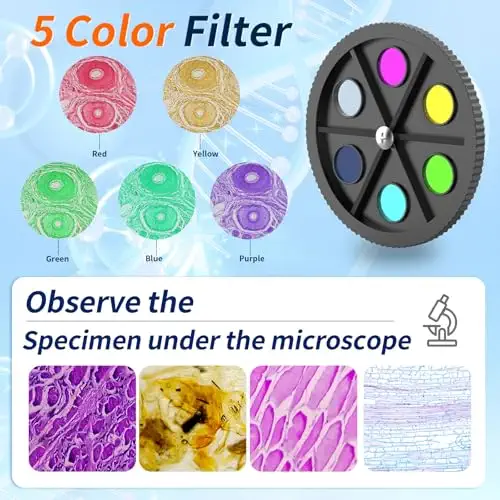

A 40x to 2500x compound scope with dual LED lights, a five-color filter wheel and a phone holder.
Prices and availability on Amazon change often.


An all-metal monocular with five magnifications up to 1000x and LED light, for beginners on a lower budget.
Prices and availability on Amazon change often.
The lead pick suits a dedicated lab or a teacher sharing one scope with a class. A cheaper monocular or a dual-light model fits a student working at home. Choose by how often the scope will be used and who will use it.
Toy microscopes often produce blurry images and lack the precision classroom work needs. Avoid them if the scope has to last through high school biology.
A compound microscope with a range of about 40x to 1000x is the typical choice for high school biology. Glass optics and a mechanical stage are the features most teachers look for.
One expert review recommends the SWIFT SW380T as the best overall student microscope, with the AmScope M150C-MS as a budget starter. The right pick depends on budget and how it will be shared.
Meet the reviewer
SEO & Content Specialist
Luka Lucheski is a content writer and editor based in N. Macedonia, with more than five years of experience in SEO and digital publishing. He has edited and reviewed hundreds of articles across a wide range of niches, from tech and software to ecommerce and everyday consumer products.
Why trust ConsumerEcho
This shortlist is built from listings compared side by side, expert and community recommendations, and a stock check on every pick. We weighed magnification range, optics, illumination, slides and camera options against what high school biology actually asks for.
Our expert team tests products when it is needed and researches online and in interviews. Every guide is fact-checked and edited by a real person.
The ConsumerEcho editorial team · Updated Oct 17, 2026
How we pickEditorial standardsAffiliate disclosureReport a mistake
We earn a commission when you buy through our links, at no extra cost to you. It never decides the winner.