
 Bucktool 2x48Best overall
- Belt size
- 2 x 48 in
- Motor
- 1 HP induction, 7A, 120V
- Belt speed
- 4500 FPM
- Worktables
- Dual cast-iron
Most recommended by reviewers
Check price at Amazon


How we make money. If you buy through our links we may earn a commission. It never changes what we recommend. Learn more ›
We earn a commission when you buy through our links, at no extra cost to you. How this works.
If you are shaping or thinning knife blades at home, a belt sander is the tool that does the heavy lifting. Getting the belt width and speed right matters more than brand, because the wrong setup either takes forever or burns the steel.
Our top pick is the Bucktool 2x48 belt sander with dual worktables and a 1 HP motor, which handles flat and curved sanding and is built for knife making. Our other picks cover budget variable-speed machines and larger belt grinders for thinning and repair work.
1 Bucktool 2x48 | 2 VEVOR 1x30 Grinder | 3 Goldsand 1x30 Sander | 4 JLD 2x72 Grinder | |
|---|---|---|---|---|
| Best for | Best overall | Best budget | Best for vertical and horizontal use | Best for large blades and thinning |
| Belt size | 2 x 48 in | 1 x 30 in | 1 x 30 in | 2 x 72 in |
| Motor | 1 HP induction, 7A, 120V | 550W pure copper | 550W pure copper | 1500W pure copper (listed) |
| Speed control | Not listed | VFD, stepless | VFD, stepless | VFD, 0-2900 rpm stepless |
| Grinding modes | Not listed | Circular and flat | Not listed | Circular, flat and arc |
| Included belts | Not listed | 100, 180, 240 grit | 100, 180, 240 grit zirconia | 60, 100, 180 grit |
| Check price at Amazon | Check price at Amazon | Check price at Amazon | Check price at Amazon |
Bucktool 2x48Best overallMost recommended by reviewers
Check price at Amazon VEVOR 1x30 GrinderBest budget
 Goldsand 1x30 SanderBest for vertical and horizontal use
 JLD 2x72 GrinderBest for large blades and thinning


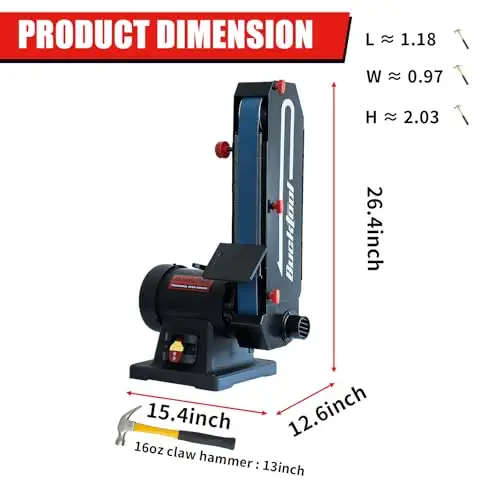

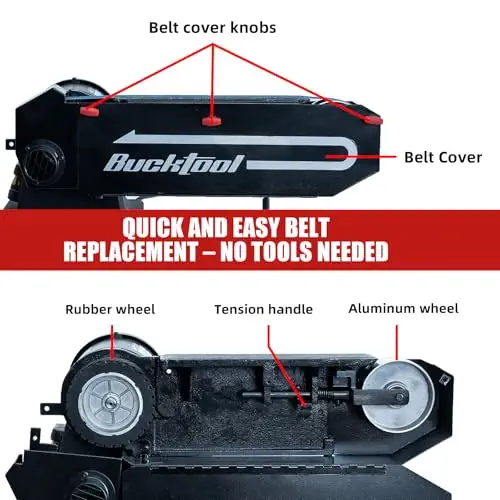
A powerful 1 HP bench sander with dual worktables, built for flat and curved knife work.
Most recommended by reviewers
Check price at AmazonPrices and availability on Amazon change often.
For knife making, we'd pick the Bucktool 2x48 Belt Sander as our top choice, since its 1 HP induction motor and 2 by 48 inch belt give it the muscle for heavy material removal.
The Bucktool runs a 1 HP induction motor at 4500 FPM, which the listing ties directly to heavy-duty grinding and knife work. Its dual cast-iron worktables and serrated rubber contact wheel make it easy to switch between flat and curved sanding, and the quick-release, tool-free belt change keeps swaps fast. Owners on r/knifemaking have not weighed in on this model, so our impression rests on the specs and listing features.
The Bucktool is heavier and costs more than the 1x30 budget machines, so it asks for more shop space and money. If that's a concern, the VEVOR 1x30 is a lower-cost starting point that commenters on r/knifemaking have praised for its motor, variable speed and belt selection.
If it's not for you, the VEVOR 1x30 Variable Speed Belt Grinder suits hobbyists on a tighter budget, and the JLD 2x72 Belt Grinder Sander suits those working with large blades and thinning.


A budget-friendly 1x30 with variable speed control, popular for home knife work.
Prices and availability on Amazon change often.


A 1x30 bench belt sander with a detachable workbench and both vertical and horizontal modes.
Prices and availability on Amazon change often.

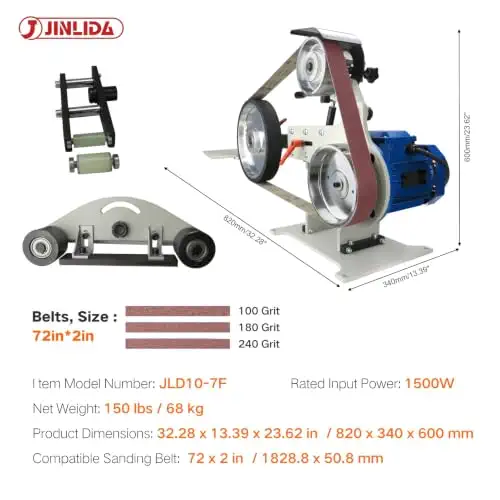


A large 2x72 industrial-style grinder for big blades, thinning and profile work.
Prices and availability on Amazon change often.
For occasional blade shaping and sharpening, a 1x30 variable-speed machine is enough. If you thin thicker blades or do regular repair work, a wider 2-inch belt is faster and runs cooler per pass.
In practice the terms overlap. Knife makers usually say belt grinder for machines built to shape and sharpen steel, while belt sander often means a general bench machine. Both use the same basic belt-and-platen design.
For most home knife makers, a 1x30 variable-speed machine is the easiest place to start. Move to a 2-inch belt if you plan to thin blades regularly.
Start with a coarse belt for reshaping and a fine belt for finishing. Owners recommend swapping belts often and treating them as consumables, using finer grits as you approach the final edge.
Release the belt tension with the quick-release handle, slip the belt on, and check that its directional arrow matches the rotation of the wheels. Then tension the belt and adjust tracking with the knob until it runs centered.
Why trust ConsumerEcho
This shortlist is built from four Amazon listings that were in stock at the time of checking, weighed against owner discussions and expert guidance on knife work. Picks are chosen for belt width, speed control and the grinding modes that suit blade shaping.
Our expert team tests products when it is needed and researches online and in interviews. Every guide is fact-checked and edited by a real person.
The ConsumerEcho editorial team · Updated Nov 15, 2026
How we pickEditorial standardsAffiliate disclosureReport a mistake
We earn a commission when you buy through our links, at no extra cost to you. It never decides the winner.