 Creality P1S All-in-one ScannerBest overall
- Accuracy
- 0.02 mm
- Scan modes
- 34 cross lines, 7 parallel lines, 1 single line
- Computer
- Built-in, 16 GB RAM, 256 GB storage
- Screen
- 6-inch touchscreen
Most recommended by reviewers
Check price at Amazon


How we make money. If you buy through our links we may earn a commission. It never changes what we recommend. Learn more ›
 Creality P1S All-in-one ScannerBest overallRunner-up2
 Creality CR-Scan Ferret ProBest budget offline pick
We earn a commission when you buy through our links, at no extra cost to you. How this works.
If you're reverse engineering a part, a car component or a prototype, you need a scanner that captures real geometry, not a rough approximation. The gap between a hobby scanner and an industrial one is mostly accuracy and how well the data drops into your CAD software.
Our No. 1 pick is the Creality Sermoon P1S, which pairs 0.02 mm accuracy with a built-in computer so you can scan on-site without a PC. The other picks cover budget offline use, larger parts and dark or shiny surfaces.
1 Creality P1S All-in-one Scanner | 2 Creality CR-Scan Ferret Pro | 3 Creality CR-Scan Raptor | 4 EinScan Rigil | 5 Revopoint MetroX Pro | |
|---|---|---|---|---|---|
| Best for | Best overall | Best budget offline pick | Best for varied part sizes | Best for dark and shiny surfaces | Best precision on a tight budget |
| Accuracy | 0.02 mm | Up to 0.1 mm | 0.02 mm | 0.04 mm | 0.02 mm single-frame, 0.01 mm precision |
| Scan modes | 34 cross lines, 7 parallel lines, 1 single line | Not listed | Up to 60 fps (blue), 20 fps (NIR) | Not listed | Cross-line, parallel, structured light, turntable |
| Check price at Amazon | Check price at Amazon | Check price at Amazon | Check price at Amazon | Check price at Amazon |
Creality P1S All-in-one ScannerBest overallMost recommended by reviewers
Check price at Amazon Creality CR-Scan Ferret ProBest budget offline pick
 Creality CR-Scan RaptorBest for varied part sizes
 EinScan RigilBest for dark and shiny surfaces
 Revopoint MetroX ProBest precision on a tight budget


A standalone scanner with 0.02 mm accuracy and a built-in computer, so you can scan at the bench or on-site without a laptop.
Most recommended by reviewers
Check price at AmazonPrices and availability on Amazon change often.
For reverse engineering on its own terms, we'd pick the Creality P1S All-in-one 3D Scanner, since its 0.02 mm accuracy is the tightest precision figure among the picks we considered for this search.
The P1S lists 0.02 mm accuracy, which suits the dimensional work reverse engineering demands. Its 34 cross lines, 7 parallel lines and single line give it several scan modes for different surfaces and edges. It runs standalone on its built-in 16 GB RAM computer with a 6-inch touchscreen, or connects to a PC wirelessly or by cable, and its dual battery setup is meant to stretch longer sessions in workshops and factories. Owners on r/3Dprinting report steady, trouble-free use for months, with one owner buying a second unit after seven months of good quality.
The P1S is expensive for a hobbyist, and its touchscreen workflow takes time to learn. If it's not for you, the Creality CR-Scan Ferret Pro is a lighter, cheaper offline option for base meshes at 0.1 mm accuracy, while the Revopoint MetroX Pro offers 0.02 mm single-frame accuracy with a turntable at a lower price, according to an expert review quoting $899.
If it's not for you, the Creality CR-Scan Ferret Pro suits budget buyers wanting a light offline scanner for base meshes, and the Revopoint MetroX Pro suits buyers wanting similar 0.02 mm precision with a turntable at a lower price.


The most affordable option here, with software that works offline after the first install.
Prices and availability on Amazon change often.


Blue laser and NIR scanning with 0.02 mm accuracy, covering parts from 5 mm up to 2 m.
Prices and availability on Amazon change often.


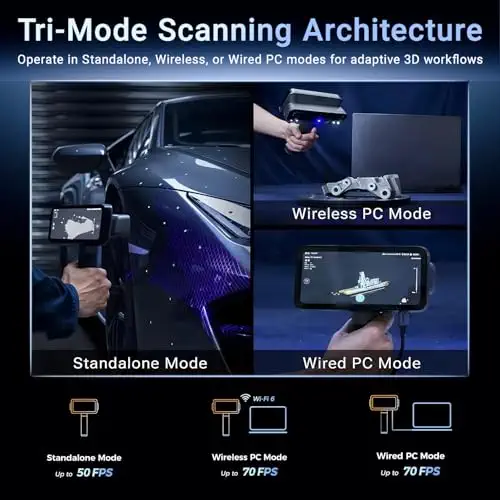
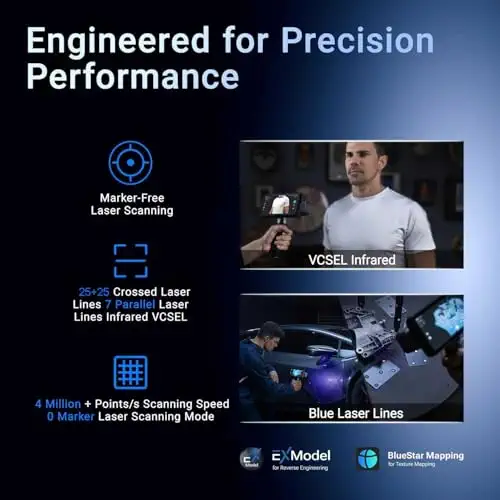

A wireless handheld with hybrid blue laser and IR VCSEL, built to scan dark and reflective metal without spray.
Prices and availability on Amazon change often.


Industrial-grade blue laser scanning down to 0.01 mm, with four scanning modes and an auto turntable.
Prices and availability on Amazon change often.
Choose the P1S or Sermoon P1 if you need industrial accuracy and want to scan without a PC. Choose the Ferret Pro for a budget offline setup where 0.1 mm is enough. The Rigil suits dark or shiny metal parts in the field.
The scanners here use manufacturer software such as CrealityScan and Revo Mirror. Check that the export formats (STL, OBJ, PLY) open in your CAD program before buying.
Phone LiDAR is far less accurate than a dedicated blue-laser scanner. For reverse engineering to tight tolerances, a dedicated unit like those on this list is the better choice.
Price tracks accuracy and how much the unit does standalone.
Yes, if you need to copy or modify existing parts. A scanner gives you a mesh you can refine in CAD and print, which saves time versus modelling from scratch.
Why trust ConsumerEcho
We built this shortlist from five Amazon listings that are in stock right now, weighing the manufacturer's stated accuracy, scanning modes and software against what our expert and reader sources said. Only models with clear offline or standalone workflows and measured accuracy figures made the cut.
Our expert team tests products when it is needed and researches online and in interviews. Every guide is fact-checked and edited by a real person.
The ConsumerEcho editorial team · Updated Nov 15, 2026
How we pickEditorial standardsAffiliate disclosureReport a mistake
We earn a commission when you buy through our links, at no extra cost to you. It never decides the winner.